________________________________________________________________________________

______________________________

Indian rosewood and Western red cedar composite double-top

______________________________


____________________________________________________________

______________________________

Indian rosewood and German spruce traditional solid-top

______________________________


____________________________________________________________

STANDARD SPECIFICATIONS:

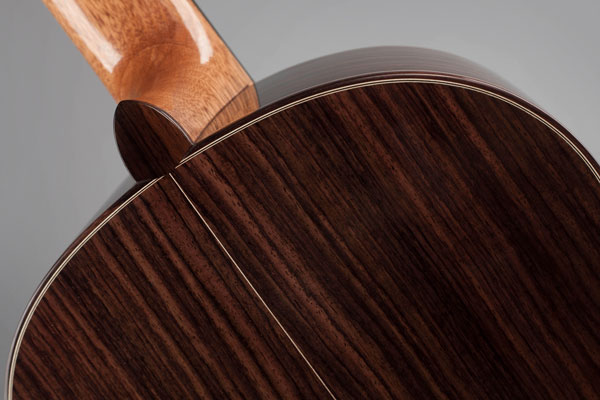
  • Indian rosewood back and sides
  • Indian rosewood binding
  • traditional solid-top, or composite double-top soundboard
  • traditional 7-fan soundboard bracing pattern
  • Mahogany neck with internal carbon fiber reinforcement
  • ebony fingerboard with raised profile
  • dual headplates
  • bone nut, bridge, and tie-block inlay
  • 12-hole bridge tie-block
  • French polish finish
  • 650mm scale length, 52mm nut width
  • Gotoh model 35G510 tuners

SOUNDBOARD OPTIONS:

  • German spruce
  • Englemann spruce
  • sitka spruce
  • western red cedar
  • Port Orford cedar

STANDARD OPTIONS:

  • hardwood armrest
  • oil-varnished neck
  • 640, 650, 660mm scale length
 

____________________________________________________________

"...raises the bar on the modern concert guitar...an extremely rich voice, with a three-dimensional quality that makes it feel almost symphonic."

Adam Perlmutter

Classical Guitar Magazine

Fall 2016 Issue 383


click the magazine image to read the full review

"With its big sound, the David Pace easily ranks among modern high-level guitars."

Philippe Spinosi

Guitar Classique Magazine

March-May 2011 No.52

METHOD AND DESIGN:

I personally build each instrument by hand with traditional methods and tools.

My goal is to produce an instrument that not only sounds good and plays well, but also holds up over time. To that end, I install robust, solid linings made from formed laminations of hardwood, as well as buttresses to further stiffen to the lower bout. The neck is internally reinforced with a solid beam of carbon fiber. These structural enhancements help to stabilize the instrument through years of string tension and to keep the playing action consistent through seasonal changes in humidity.

I construct guitars with traditional solid soundboards as well as composite double-top soundboards. The soundboard bracing designs are slightly different between the two, and are my own variations of a traditional 7-fan pattern.

Regarding tonality, my goal is to render warm, yet firm bass notes with maximum sustain, a rich and complex midrange, and a high register that presents a strong fundamental while maintaining good definition and clarity. I work toward even balance and separation of compositional voices, and responsiveness to playing dynamics.

FINISH:

I use a traditional French polish of shellac varnish.

A French polish is the result of a centuries-old method of applying a shellac-based spirit varnish by hand to slowly build a gloss finish over several varnishing sessions.

As a standard option, the neck can be alternatively finished with oil varnish. The oil varnish is rubbed into the grain of the wood where it cures to create a protective barrier. An oil varnish finish is not glossy, but rather has a matte luster. One will notice a significant reduction in friction when moving through positions on the fingerboard.

OPTIONAL ARMREST:

The hardwood armrest is beveled underneath, so it does not make contact with the vibrating portion of the soundboard. This eliminates damping caused by forearm contact while also protecting the varnish on the soundboard surface. Additionally, the slight bevel on top serves to distribute the weight of the forearm, which enhances comfort while also reducing friction during right arm movement.

MOSAIC:

The mosaic rosette hardwood inlay is made from bloodwood, maple, holly, and sycamore.


___________________________________________________________

Copyright © 2011-2025 David J. Pace